Three one-stroke drawing puzzles, with answers and a printable sheet
Can you trace each figure without lifting your pencil or retracing a line? Two can be done. One cannot. Find a route—or a reason to stop trying.
The rules
Use paper and a pencil, trace the picture with a finger, or write a route as letters. You can solve this on your own or compare routes with a friend. The pictures on this page are static; they do not record your strokes.
- Follow only the printed lines and use each line exactly once. A line joins two labeled dots.
- You may return to a dot several times. You may not retrace a line, even in the opposite direction.
- You choose the starting dot; finding one that works is part of the puzzle. Turn or continue at the dots. There are no unmarked crossings.
- For each picture, either write a complete route or explain why no such route is possible.
Download the puzzles and answers (PDF, 2 A4 pages)
Page 1 has the puzzles; page 2 has routes and explanations. Use Fit to page. You may print and share the complete file unchanged. All tasks and answers are also readable on this page.
1. The shortcut
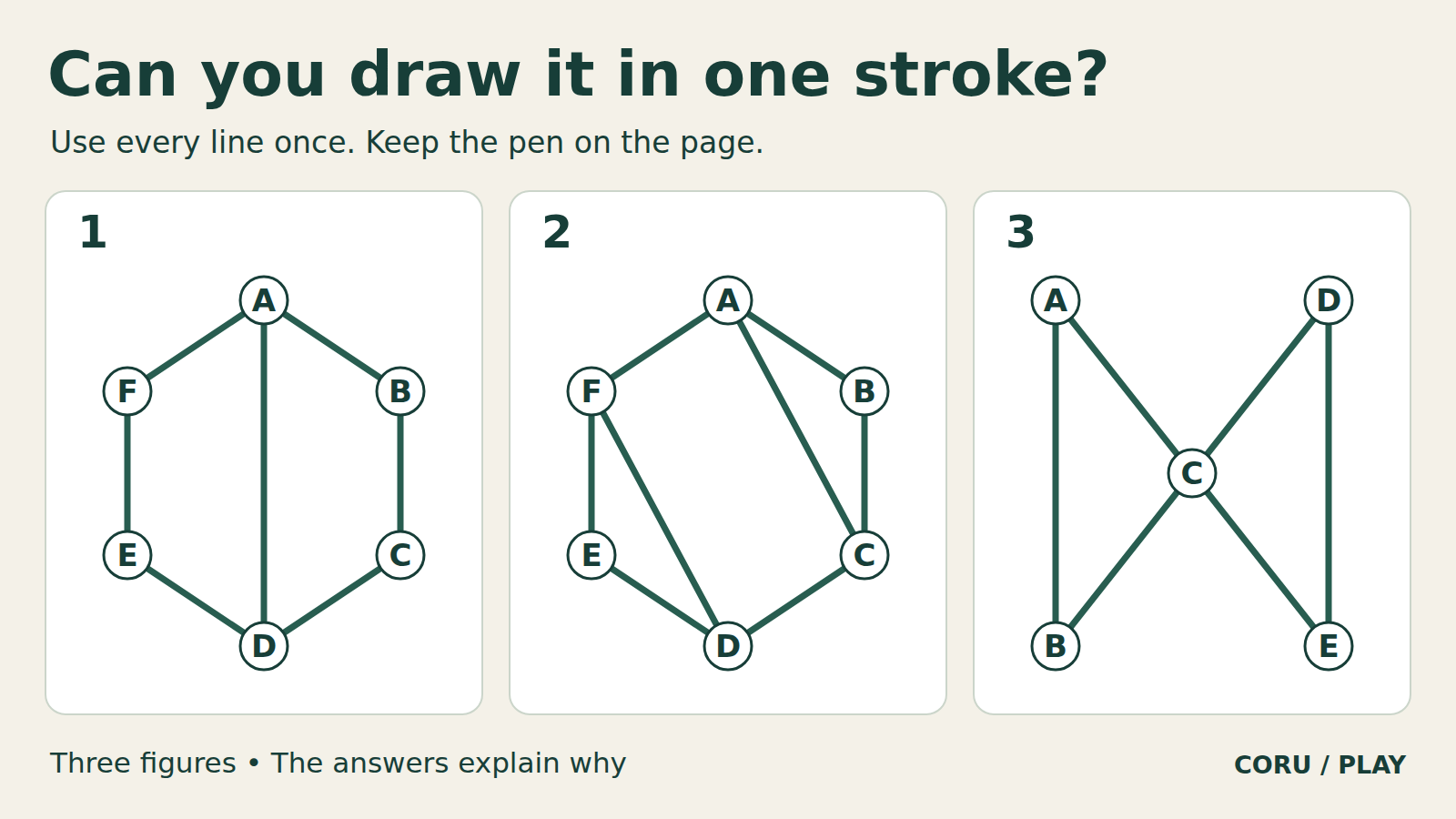
A six-sided loop has one line straight through the middle. Find a starting dot that lets you use all seven lines.
Text version: the lines are AB, BC, CD, DE, EF, FA and AD. AB and BA mean the same line.
2. The two corners
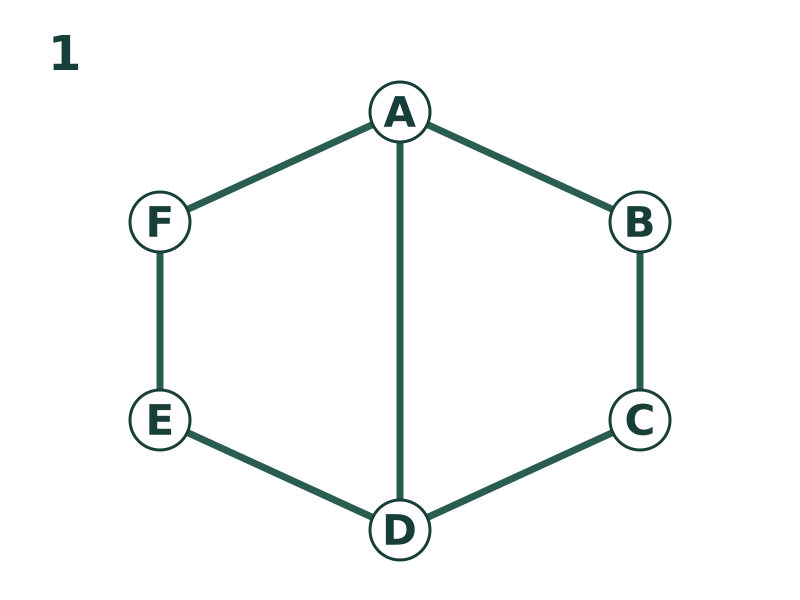
This loop has eight lines, including two diagonals. Can you use all eight without lifting your pencil? A convincing impossibility argument counts as a solution.
Text version: the lines are AB, BC, CD, DE, EF, FA, AC and DF.
3. The meeting point
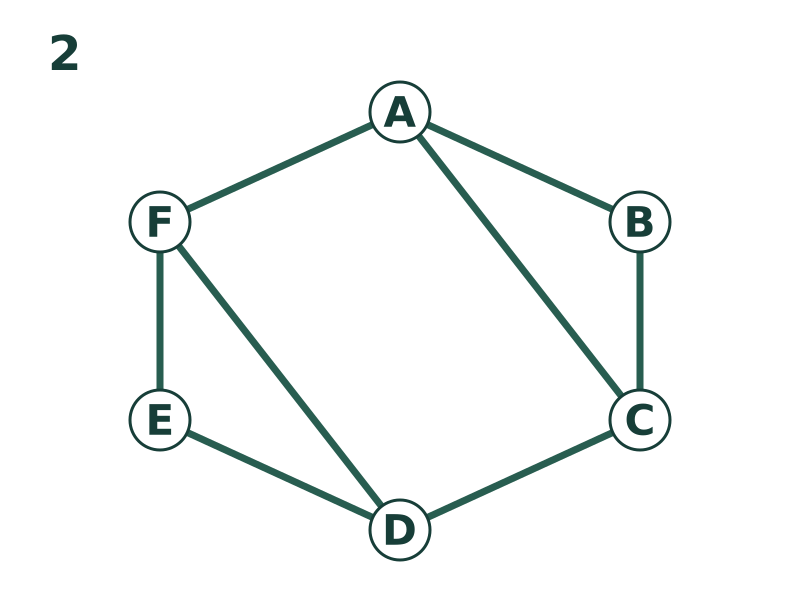
Two triangles meet at C. Trace all six lines and finish where you started. You may pass through C more than once.
Text version: the lines are AB, BC, CA, CD, DE and EC.
A hint before the answers
At each dot, count how many lines meet there. Can you match each arrival with a departure? A starting point and an ending point can each have one unpaired line. Keep this in mind when you choose where to begin.
Answers: routes and a reason
1. One route is A → B → C → D → E → F → A → D. It uses all seven lines once. A and D each have three incident lines; the other dots have two. You must start at A and finish at D, or reverse that choice.
2. There is no one-stroke route. A, C, D and F each have three incident lines; B and E each have two. Four dots need an unpaired arrival or departure, but a single stroke has only two ends. Changing your starting dot cannot fix this.
3. One route is A → B → C → D → E → C → A. It uses all six lines and returns to A. C has four incident lines, and every other dot has two. Other starting dots and routes are possible.
The quick test
For a connected figure with undirected lines, count the dots with an odd number of incident lines. With none, a route exists that returns to its starting dot. With exactly two, a route exists between those two dots. With more than two, one stroke is impossible.
Connected matters: you must be able to get from any dot to every other by following lines. Two separate triangles each have only even counts, but you cannot trace both in one stroke.
This is the Euler-trail rule. Count lines, not just visits to dots: a valid route can revisit a dot. The rule tells you whether a route exists, but a careless turn can still leave unused lines behind.
Make one change
In puzzle 2, erase AC. A and C now have two lines each; D and F still have three. Can you find a route from D to F?
One answer: D → C → B → A → F → E → D → F. Check it against the seven remaining lines, crossing off each one as you go.
Try drawing your own connected figure. Before giving it to someone else, count the odd dots and check a full route. If it is impossible, ask for an explanation rather than promising a solution.
About these puzzles
Coru arranged these diagrams, the exercise sequence and the printable sheets. One-stroke puzzles and the mathematical rule are well established. We checked the listed routes and exhaustively searched all possible edge-use routes for these three figures; this is not a claim that the graphs have never appeared elsewhere.