Play and imagination
Nonograms for beginners: three 5×5 puzzles with printable PDFs
Turn numbers into a small black-and-white picture. Try three original 5×5 puzzles, one step at a time, on paper or by copying the grids. Each has one solution and can be solved without guessing.
Choose your sheet
The PDF has two pages: puzzles first, answers second. Print only page 1 to keep the answers out of sight. Choose the paper size your printer uses; the exact printed size of the cells does not affect these puzzles.
You can also draw three grids, each five squares wide and five squares tall. Copy the clues shown below. The images on this page are reference grids, not clickable game boards. Work alone, or take turns explaining a cell you can prove.
Download A4 puzzle sheet
Two pages: three puzzles, then answers and first moves. English.
Download LETTER puzzle sheet
Two pages: three puzzles, then answers and first moves. English.
Read the numbers before filling a cell
A number is the length of a consecutive filled block. Read row clues from left to right and column clues from top to bottom. A clue of 2 1 means a block of two filled cells, then at least one empty cell, then one filled cell. It does not mean any three filled cells.
There must be at least one empty cell between two blocks in the same line. A block may touch an edge, but does not have to. Mark a confirmed empty cell with ×; leave an undecided cell blank. Every row and every column must match its clues.
How to start when a line is not full
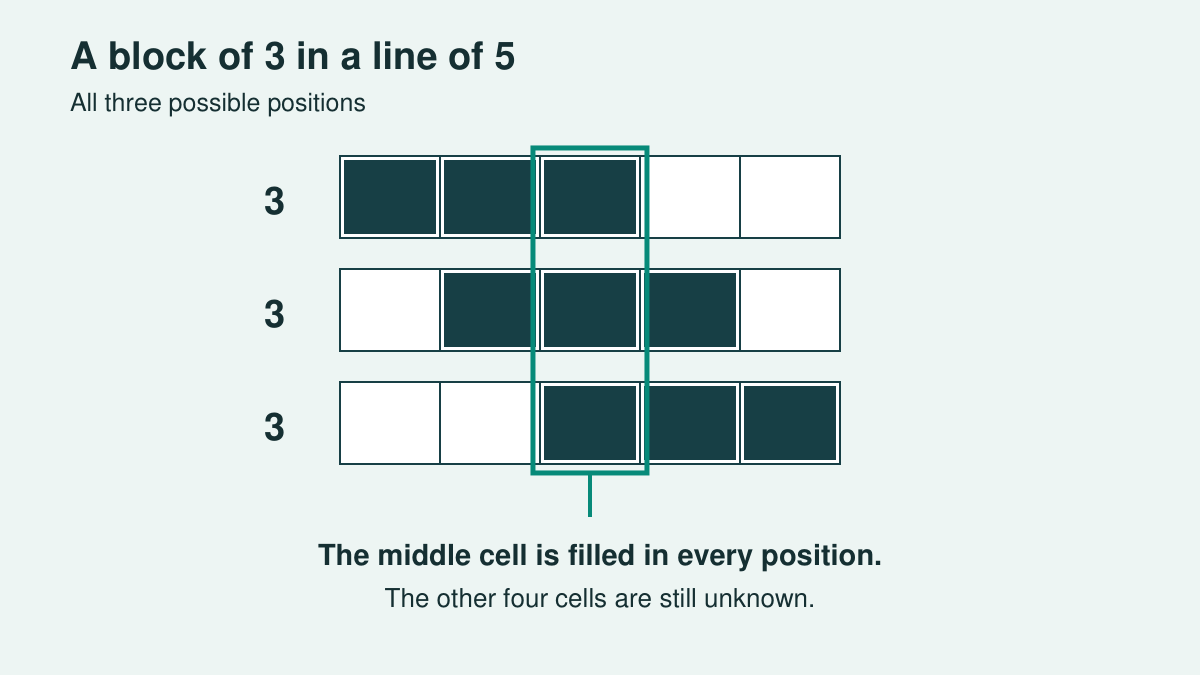
For a five-cell line with the single clue 3, the block can occupy cells 1–3, 2–4 or 3–5. Cell 3 is filled in every possibility: fill that cell now. The other cells are still undecided. This shared position is called overlap.
Compare a row with the columns it crosses. A new filled cell or × may leave only one possible position for a block in the next line. After a line has all its filled cells, mark its remaining cells ×.
Three puzzles to try
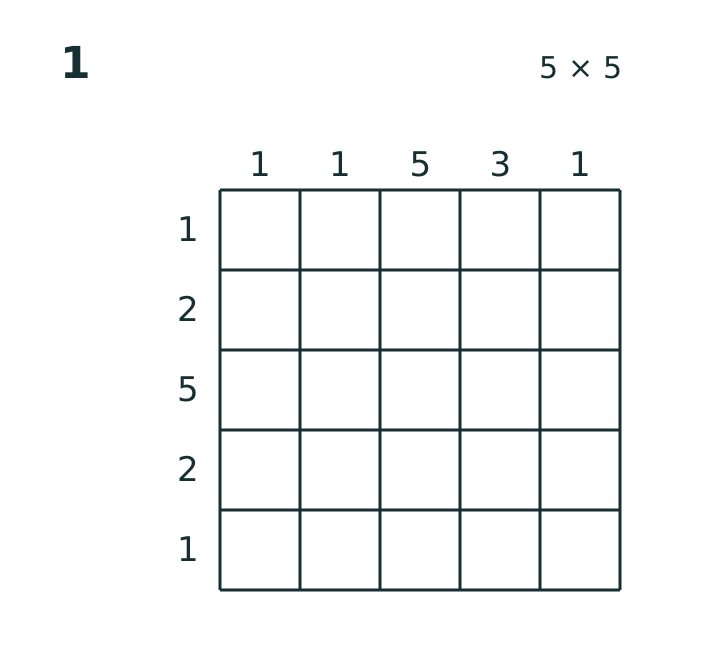
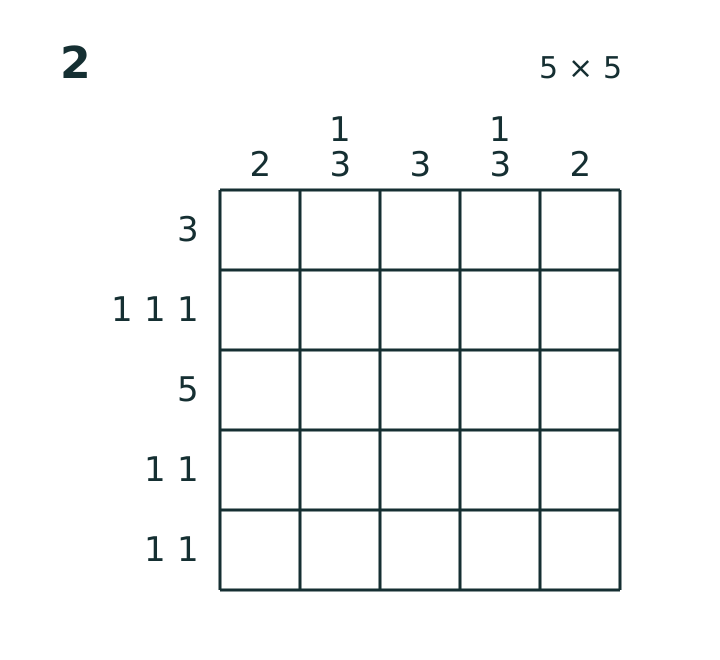
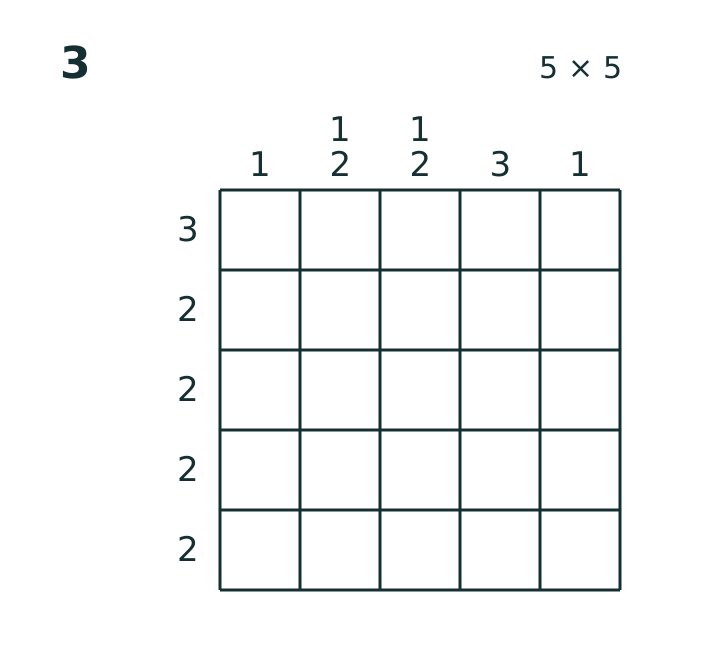
Rows are numbered 1–5 from top to bottom; columns 1–5 from left to right. The text clues repeat the image: within one line, spaces separate blocks; a semicolon starts the next row or column. Stop before “Hints” if you want to work unaided.
Puzzle 1: full lines
Fill a line whose clue equals its length, then mark the remaining cells of completed groups empty.
- Rows, top to bottom: 1; 2; 5; 2; 1.
- Columns, left to right: 1; 1; 5; 3; 1.
Puzzle 2: leave a gap
Separate consecutive groups by at least one empty cell; include those gaps when counting the space needed.
- Rows, top to bottom: 3; 1 1 1; 5; 1 1; 1 1.
- Columns, left to right: 2; 1 3; 3; 1 3; 2.
Puzzle 3: find the overlap
Compare all possible positions of a group. Fill only cells that must be filled in every position.
- Rows, top to bottom: 3; 2; 2; 2; 2.
- Columns, left to right: 1; 1 2; 1 2; 3; 1.
Hints — one first move per puzzle
- 1. Row 3 and column 3 both have clue 5: fill all five cells in each.
- 2. Row 2 has clues 1, 1, 1. Three filled cells plus two required gaps use all five cells: fill columns 1, 3 and 5.
- 3. A block of 3 in a five-cell line always covers its middle cell. Fill two cells: (row 1, column 3) and (row 3, column 4).
Answers and worked steps
The answers follow here and on page 2 of each PDF. In the text grids, # means filled and . means empty. Each line below is one row, read from top to bottom. Check the row clues and then the column clues against your finished grid.
Answer 1
..#..
..##.
#####
..##.
..#..
An arrow. # = filled; . = empty.
Steps for puzzle 1
- Fill all of row 3 and column 3, because each has clue 5.
- Columns 1, 2 and 5 have clue 1. Their filled cell in row 3 completes the clue, so mark every other cell in those columns empty.
- Rows 1 and 5 also have clue 1. Their filled cell in column 3 completes the clue; mark column 4 empty in both rows.
- Rows 2 and 4 have clue 2. Each already has column 3 filled and column 2 empty, so extend the block into column 4.
- Column 4 now has its three-cell block in rows 2–4. Every row and column matches its clue.
Answer 2
.###.
#.#.#
#####
.#.#.
.#.#.
A little robot. # = filled; . = empty.
Steps for puzzle 2
- Row 2 has clues 1, 1, 1. The three filled cells and two separating empty cells exactly fit the row: fill columns 1, 3 and 5; mark columns 2 and 4 empty.
- Columns 2 and 4 each have clues 1, 3. Fill row 1, leave row 2 empty, and fill rows 3–5 in both columns.
- Fill all of row 3, whose clue is 5.
- Columns 1 and 5 have clue 2, already satisfied by rows 2 and 3. Mark rows 1, 4 and 5 empty in each.
- Row 1 has clue 3 and filled cells in columns 2 and 4. Fill column 3 to join them into one block.
- Column 3 now has its complete block of three in rows 1–3. Mark rows 4 and 5 empty. Check the two separated single cells in each of rows 4 and 5.
Answer 3
.###.
...##
..##.
.##..
##...
A zigzag ribbon. # = filled; . = empty.
Steps for puzzle 3
- A block of 3 in five cells can occupy positions 1–3, 2–4 or 3–5. All include position 3. Fill two cells: (row 1, column 3) and (row 3, column 4).
- Columns 2 and 3 have clues 1, 2. Their three possible patterns are filled–empty–filled–filled–empty; filled–empty–empty–filled–filled; empty–filled–empty–filled–filled. Row 4 is filled in every pattern. Fill row 4, columns 2–3. Its clue 2 is complete: mark columns 1, 4 and 5 empty.
- In column 3, the filled cell in row 1 is the first single-cell group. Mark row 2 empty to separate it from the later two-cell group.
- Column 4 has clue 3. Row 3 is filled and row 4 is empty, so the block must occupy rows 1–3. Fill rows 1 and 2, and mark row 5 empty.
- Row 2 has clue 2, column 4 filled and column 3 empty. Fill column 5 and mark columns 1–2 empty. Column 5 has clue 1, now complete: mark all its other cells empty.
- Row 1 has clue 3 and filled cells in columns 3–4. Column 5 is empty, so its block is columns 2–4. Fill column 2 and mark column 1 empty. In column 2, row 1 is the first single-cell group: with row 2 empty and row 4 filled, the two-cell group could still use rows 3–4 or 4–5.
- Row 3 has clue 2 and column 4 filled. Column 5 is empty, so fill column 3 and mark columns 1–2 empty. This rules out rows 3–4 for the two-cell block in column 2; fill row 5, column 2.
- Column 1 has clue 1 and rows 1–4 empty. Fill row 5, column 1. Row 5 now has its two filled cells in columns 1–2: mark its remaining cells empty. Check all row and column clues.
About this set
The three grids, explanations and printable sheets were created for Coru. We checked every arrangement compatible with the row clues against the column clues: each puzzle has exactly one solution. A separate line-by-line check reached all 25 cells without guessing.
These are small practice puzzles, not a timed test. We have not measured completion time with beginners. The PDF files have been checked on screen; we have not tested a physical print. You may print and share the unchanged sheets. The rules reference below describes the established puzzle format; its example puzzles are not reproduced here.