Same mark, two drawings: a paper game for two
Start with the same line, then turn it into two different pictures. One person's arch might become a bridge; the other's, a beetle's back. All you need is paper and something to draw with. You can play without a timer, scores or a judge.
Play the first round
- 1. Take a sheet each. Both draw a small arch in the middle, like an upside-down U. Leave room around it.
- 2. One player turns the arch into a living creature; the other turns it into an object or place. Keep your pictures hidden while you add to them.
- 3. Add lines and turn the paper as you like. Keep the starting arch as part of the picture; do not erase it or cover it completely.
- 4. When you are both ready, reveal the pictures. Find the starting arch in each one, then explain what you drew.
- 5. Choose another mark for the next round and swap tasks: whoever drew a creature now draws an object or place.
How one arch becomes two pictures
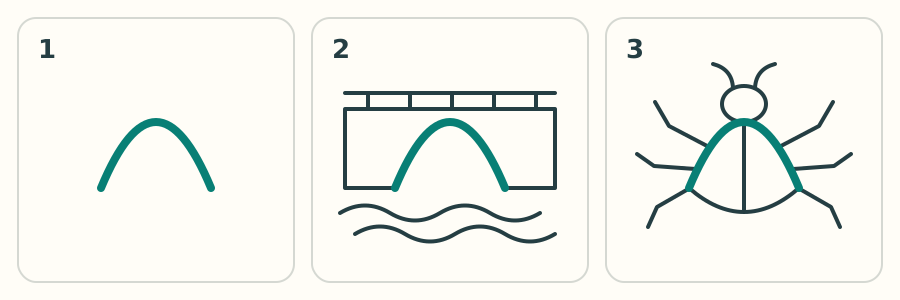
The arch could be a beetle's back, with legs and feelers added around it. In the other picture, the same arch could be part of a bridge over a river. Those are two examples; yours can be completely different.
Six marks to start with
Copy any mark. Your copies do not need to match perfectly; start with the same simple shape.
Start with the arch or wave if you would rather get drawing. Stop after any round, or take another sheet and make up your own marks.
- An arch: one smooth curve, open at the bottom.
- A wave: one shallow wavy line.
- A corner: two joined straight lines, like an L.
- A loop: a small closed oval with a short straight tail.
- Three dots: place them in an uneven triangle.
- Two bars: a short and a long parallel line.
When you cannot see a picture
Turn the paper a quarter turn. Try seeing the line as an edge, path, handle, back or opening. You can draw the most obvious thing first—perhaps a magnifying glass from the loop—then add one unexpected detail.
If the task gets in the way, drop it and both draw whatever comes to mind. For an extra constraint, agree to add no more than ten lines. You do not have to count every movement of the pencil; decide together what counts as a line before you start.
Two more ways to play
Swap sheets. Each person draws a mark and hands it to the other. Turn the mark you receive into a picture. The starting shapes are different this time, so look for surprising additions rather than matching results.
Play alone. Repeat one mark in three places, then make three pictures: a creature, an object and a place. Try another angle or scale if the third idea is hard to find.
After the reveal
You do not need to pick a winning picture. After the reveal, try asking, “How did you get that idea?” or “What one detail would you add?” Keep drawing together if you both want to.
About this version
Other drawing games also use simple starter marks and swapped pictures. Coru prepared the six starting marks, paired tasks and examples for this version. You can find other variations in Drawing Games from The Painted Turtle.