Play and imagination
4×4 Sudoku for beginners: three printable puzzles and a worked solution
Start with just four digits. These three original 4×4 Sudoku puzzles each have one solution and can be solved without guessing. Copy a grid to paper or print the sheet; use the first-move hints and the worked solution when you need them.
Get the puzzle sheet
Each PDF has two pages: puzzles on page 1, answers and starting hints on page 2. Print only page 1 to keep the answers out of sight. Choose A4 or Letter to match your paper; fitting the page is fine for these puzzles.
You can also copy the grids below onto paper. The webpage is a guide and printable activity; its grid pictures are not input fields.
Download A4 puzzles
Two pages: three puzzles, then answers and starting hints. English.
Download LETTER puzzles
Two pages: three puzzles, then answers and starting hints. English.
Three places to check before writing a digit
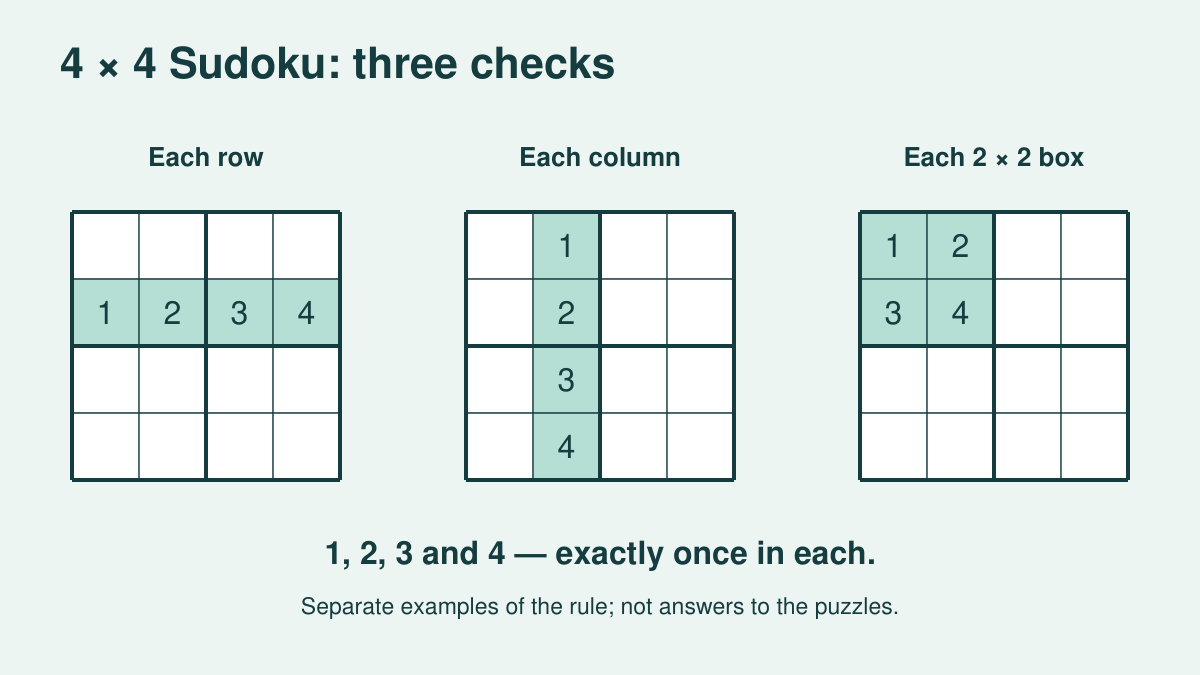
Use 1, 2, 3 and 4. Every row, every column and every thick-outlined 2×2 box must contain all four digits once. Keep the starting digits where they are.
A row goes across; a column goes down. The thick lines divide the grid into four boxes. Diagonals have no extra rule in these puzzles. You do not add the numbers together.
For any empty cell, cross out the digits already used in its row, column and box. If only one digit remains, write it. Then look again: your new digit may settle another cell. If two choices remain, leave that cell for now.
Try the three grids
Rows are numbered 1–4 from top to bottom; columns 1–4 from left to right. In the text copies, a dot means an empty cell. The vertical bar and middle divider mark the 2×2 boxes.
Begin with puzzle 1 if you want to follow the full walkthrough. Puzzles 2 and 3 have fewer starting digits, but fewer clues alone do not tell you how hard a puzzle will feel.
Puzzle 1
Eight starting digits. All eight empty cells are explained below.
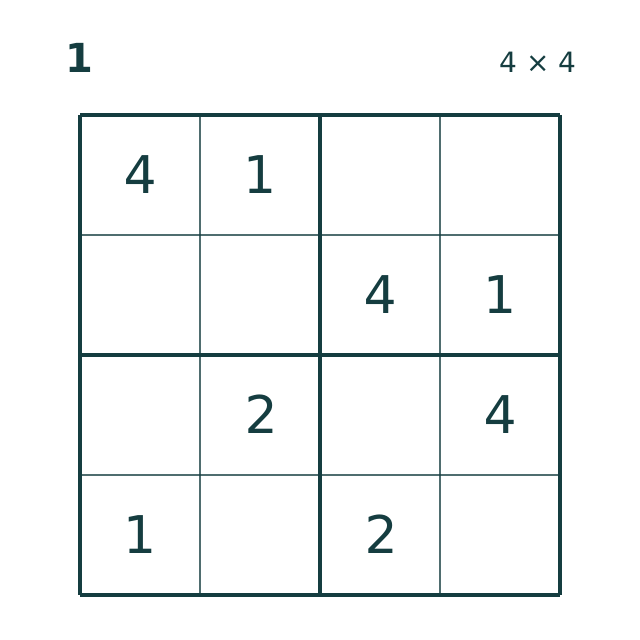
Puzzle 1 as text
4 1 | . .
. . | 4 1
----+----
. 2 | . 4
1 . | 2 .
A dot is a blank cell. Keep the given digits.
Puzzle 2
Six starting digits. Check the cell’s row, column and box.
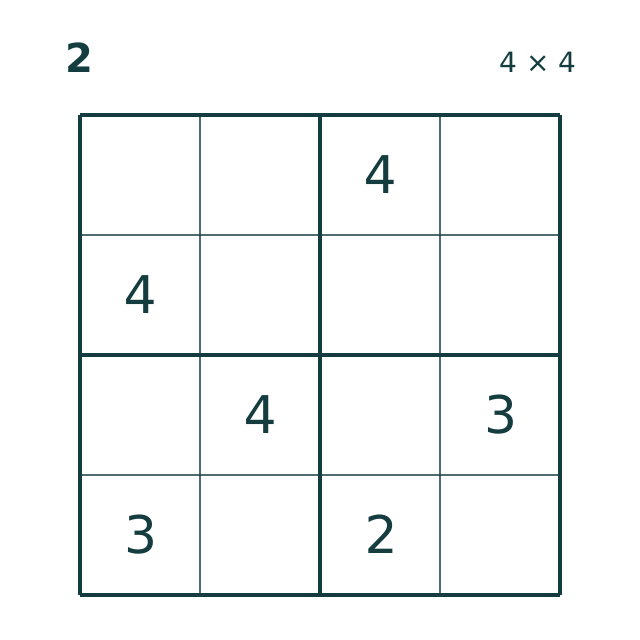
Puzzle 2 as text
. . | 4 .
4 . | . .
----+----
. 4 | . 3
3 . | 2 .
A dot is a blank cell. Keep the given digits.
Puzzle 3
Five starting digits. Combine all three checks before choosing a number.
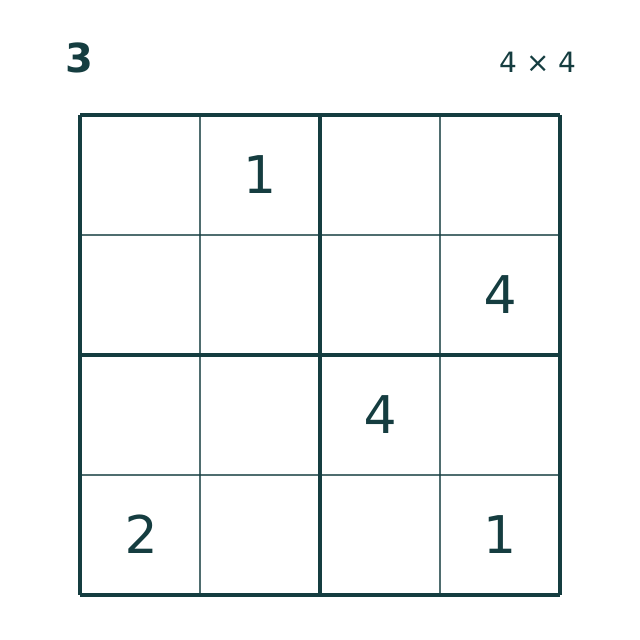
Puzzle 3 as text
. 1 | . .
. . | . 4
----+----
. . | 4 .
2 . | . 1
A dot is a blank cell. Keep the given digits.
First-move hints
Stop here if you still want to solve on your own. Each hint supplies one forced move; the answers follow further down.
- 1. Row 1, column 3: row 1 already has 1, 4; column 3 has 2, 4; its 2×2 box has 1, 4. Together they rule out every number except 3. Write 3.
- 2. Row 3, column 3: row 3 already has 3, 4; column 3 has 2, 4; its 2×2 box has 2, 3. Together they rule out every number except 1. Write 1.
- 3. Row 2, column 1: row 2 already has 4; column 1 has 2; its 2×2 box has 1. Together they rule out every number except 3. Write 3.
Why checking only the row can fail
Look at puzzle 1 before filling anything. Row 1 contains 4 and 1, so it still needs 2 and 3. That does not mean either digit can go in either gap.
At row 1, column 3, a 2 would repeat the 2 already in column 3 at row 4. Its upper-right box contains 4 and 1. Only 3 passes all three checks, so the first move is row 1, column 3 = 3.
Puzzle 1: all eight steps
Follow these steps in order. Every move uses the original digits plus the moves already made.
- 1. Row 1, column 3 = 3. The row needs 2 or 3, but column 3 already contains 2.
- 2. Row 1, column 4 = 2. It is the only missing digit in row 1.
- 3. Row 2, column 2 = 3. Row 2 needs 2 or 3; column 2 already contains 2.
- 4. Row 2, column 1 = 2. It is the only missing digit in row 2.
- 5. Row 3, column 1 = 3. Column 1 now contains 4, 2 and 1.
- 6. Row 3, column 3 = 1. Row 3 now contains 3, 2 and 4.
- 7. Row 4, column 2 = 4. Column 2 now contains 1, 3 and 2.
- 8. Row 4, column 4 = 3. It is the only missing digit in row 4.
Complete answers
Match the puzzle number. Check that the starting digits are unchanged and that each row, column and 2×2 box has 1, 2, 3 and 4 once. A finished-looking grid can still contain a repeat.
Answer 1
4 1 | 3 2
2 3 | 4 1
----+----
3 2 | 1 4
1 4 | 2 3
Check every row, column and box.
Answer 2
1 3 | 4 2
4 2 | 3 1
----+----
2 4 | 1 3
3 1 | 2 4
Check every row, column and box.
Answer 3
4 1 | 2 3
3 2 | 1 4
----+----
1 3 | 4 2
2 4 | 3 1
Check every row, column and box.
If your grid stops working
If a cell has no possible digit, check your recent entries and the original clues for a copying error. If it has several possible digits, that cell alone does not yet give you a forced move; inspect another one.
Pencil notes are possibilities, not filled digits. After making a firm move, remove that digit from notes in the same row, column and box. When solving together, ask “Which existing digit rules that out?” before giving the answer.
About these puzzles
Coru constructed these grids and checked each against every valid completed 4×4 grid. Each has exactly one answer, and a sequence of single-possible-digit moves fills every blank. These checks do not measure a beginner’s completion time.
You may print and share the complete PDF sheets unchanged. The rules follow standard mini Sudoku; the grids, explanations and layout were prepared for this guide. Small Sudoku grids can coincide with other published puzzles.