Two notes: up or down? The person next to you may hear the opposite
There is no right answer. Only your ears.
Two notes
The buttons or the ↑ ↓ keys; R plays the pair again.
Is the second note higher or lower than the first?
You need sound, ideally headphones. Set a comfortable volume first. A phone on silent may mute it. The ↑ ↓ keys answer, R plays the pair again.
The same test without buttons
Play the recording below: 12 pairs with 4 seconds between them. For each pair decide whether it goes up or down, and circle the note that sounded higher.
If you have a circle, the circled notes gather on one half of it: C, C♯, D, D♯, E, F, F♯, G, G♯, A, A♯, B and back to C. The middle of that half is your peak.
| Pair | Notes | Up or down |
|---|---|---|
| 1 | D → G♯ | ↑ ↓ |
| 2 | F → B | ↑ ↓ |
| 3 | A → D♯ | ↑ ↓ |
| 4 | C → F♯ | ↑ ↓ |
| 5 | G → C♯ | ↑ ↓ |
| 6 | A♯ → E | ↑ ↓ |
| 7 | D♯ → A | ↑ ↓ |
| 8 | F♯ → C | ↑ ↓ |
| 9 | C♯ → G | ↑ ↓ |
| 10 | E → A♯ | ↑ ↓ |
| 11 | G♯ → D | ↑ ↓ |
| 12 | B → F | ↑ ↓ |
What these sounds are
Everyone who opens this page hears the same sounds. The notes in each pair are exactly half an octave apart, a tritone, and in the usual sense the second note is neither higher nor lower than the first. Apart from two control pairs, there is no right answer.
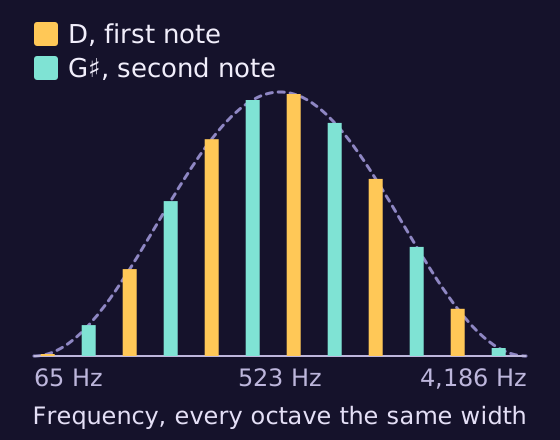
Each note is built from six pure tones, one per octave, and one smooth bell sets their loudness: loudest in the middle, next to nothing at the edges. The note is clear, say D, but your ear cannot decide which octave it is in. And from D to G♯ is half an octave whether you go up or down. There is no shorter way, and none of the usual clues.
Why you still have an answer
In 1986 the psychologist Diana Deutsch of the University of California, San Diego described a pair of notes like this: in one key it rises, in another it falls, and a recording played at a different speed changes direction. And one more oddity: in the same key, some people hear it rise and others hear it fall. The effect is now known as the tritone paradox.
An ordinary melody does not behave like that: in another key it keeps its shape. Deutsch compared this paradox to a circle turning into a square just because it was moved to the side.
For most listeners the answers are not random. Set the twelve notes around a circle like the hours on a clock, and the notes on one half of the circle sound higher to a given person, those on the other half lower. Deutsch called the top notes of this circle the peak. Different people have the peak in different places, so they hear the same pair going in opposite directions.
California and southern England
In 1991 Deutsch compared 24 people who grew up in California with 12 who grew up in southern England. They were screened in advance on pure tones and heard the pairs through headphones in soundproof booths. For the English group the peak most often fell on F♯, G and G♯; for the Californians, on B, C, C♯, D and D♯. In the half of the circle typical of Californians, the peak fell for 21 of the 24 Californians and only 3 of the 12 English listeners.
In 2004 people from Vietnam were compared with Californians. Sixteen had arrived in the United States as adults and spoke mainly Vietnamese. Another 16 had arrived as infants or children and now spoke mainly English, though they lived with parents or Vietnamese roommates and often heard Vietnamese. These two groups heard the pairs similarly, and both differed from 10 Californians.
In a 2007 study, each of 15 children and adult offspring had a peak closer to their mother's than to the average of the other mothers': 1.3 semitones against 3.17, where chance alone would give about 3. The offspring had spent all or most of their lives in California, while the mothers grew up in many different places.
Deutsch's explanation is that in early childhood you absorb the pitch of the speech around you, and that template turns your circle of notes. In her experiments the peak corresponded to the range of the person's own speaking voice.
This is disputed
In a 1993 conference paper Bruno Repp compared Dutch, British and American listeners and reported very similar results across the groups. He found no link with vocal range in any of them, while the spectrum of the sound itself changed the answers strongly and systematically. His conclusion: this comes from how hearing processes sound, not from a language template. Yet in posts to a research mailing list that same October he added that on one of his two sets of tones Americans and southern British listeners did differ, though not exactly as in Deutsch's data.
Deutsch answers, in a reply to Repp's 1994 journal paper, that the results cannot be compared directly with hers: the groups were different (only 6 of his 17 Americans were Californians, and his groups heard different sets of spectra), and he measured vocal range differently and compared it with the answers on one spectrum only. Where the spectrum matters this much, she adds, answers must be averaged across spectra, as in her experiments. We could not read the 1994 paper itself and know it from the conference paper, the posts and this reply.
Other laboratories have found such differences too. Deutsch reports their work this way: listeners in Florida resembled Californians, those in Hamilton, Ontario resembled the southern English, and Swedes in Stockholm differed from Texans and Californians. We have not read those papers themselves.
Others found the opposite. Germans and Japanese did not differ systematically in a 2002 study by Krüger and Lukas, which we know only from a summary in a 2018 paper by Malek and Sperschneider. That paper's introduction sums up the field: in most studies the position of the spectrum barely changed most people's answers, in a few it changed them markedly, and some listeners seem to follow the spectrum rather than the note.
And not everyone has a clear circle. In a 1994 conference paper a statistically significant bias appeared in 83% of 18 musicians and 33% of 9 other listeners, although in Deutsch's studies musical training made no difference. Its authors say this supports a template with a definite orientation, and the bias they found matched Deutsch's Californians; where they part from her is the role of training.
So a peak cannot tell where someone is from. It describes only how you heard these pairs today on these speakers. These studies cover few languages: none, for example, is Russian, and we found no such data.
What this test can do
In the 1991 experiment one person gave 384 answers. Here the first round scores 12, plus two control pairs, so the result is rough. To make it mean something anyway, we work out how often random answers would match this well. A perfect circle from 12 pairs comes up by chance 12 times in 4096, or 0.29%, and 11 pairs or more about 3.2% of the time.
A pair and its reverse play under spectra half an octave apart: their spectra have the same shape while the notes swap places. That relation comes from Deutsch's experiments; alternating the spectra inside a round and judging from them what leads you is our design. If the note leads you, your answer to the second pair reverses. If the spectrum leads you, your answer stays the same. Over four rounds you hear all 48 pairs of her set.
Two pairs in the first round use ordinary pure tones, and their direction is real. The 1991 and 2007 experiments screened people on pairs like these: no more than 6 errors in 48. A phone speaker reproduces the lower parts of the tone poorly, so on a phone the sound is further from the experiment than on headphones.
How the sound is made
The loudness of each component follows the formula in Deutsch's papers: A(f) = 0.5 − 0.5 · cos(2π/6 · log₂(f / fmin)), from fmin to 64 fmin. The spectrum centres are hers: 262, 370, 523 and 740 Hz. Each note lasts 500 ms, with no gap inside a pair. Your browser computes the sound on the spot, and all notes have equal power, so loudness gives no clue in the signal itself. We chose the 20 ms fade in and out and the starting phases: these papers do not specify them. The frequencies and levels of the components were measured in the finished signal and match the formula.
A recording for a group
Deutsch advises showing this effect to a group and asking for a show of hands. Play the recording out loud, have everyone mark up or down, then compare. The order of the pairs is in the version without buttons.
Twelve pairs in a row
Transcript
A recording without words: twelve pairs of notes, each lasting a second, with 4 seconds between pairs. Order: D → G♯, F → B, A → D♯, C → F♯, G → C♯, A♯ → E, D♯ → A, F♯ → C, C♯ → G, E → A♯, G♯ → D, B → F.
Which of you is right
Neither. The notes in the recording have no definite octave, and so the pairs have no direction. Your hearing supplies one, by its own rule, and from the inside that rule feels like the sound itself. Send the test to a friend. If they hear the opposite, there is nothing to argue about, and you will argue anyway.
Sources & further reading
- Diana Deutsch. A Musical Paradox. Music Perception, 1986
- Diana Deutsch. The Tritone Paradox: An Influence of Language on Music Perception. Music Perception, 1991
- Diana Deutsch, Trevor Henthorn, Mark Dolson. Speech Patterns Heard Early in Life Influence Later Perception of the Tritone Paradox. Music Perception, 2004
- Diana Deutsch. Mothers and Their Offspring Perceive the Tritone Paradox in Closely Similar Ways. Archives of Acoustics, 2007
- Bruno H. Repp. The tritone paradox and speakers' voice range: A dubious connection. Acoustical Society of America meeting, 1993
- Bruno H. Repp. National differences in the tritone paradox. Post to the AUDITORY list, 26 October 1993
- Bruno H. Repp. A can of worms. Post to the AUDITORY list, 27 October 1993
- Diana Deutsch. The Tritone Paradox and the Pitch Range of the Speaking Voice: Reply to Repp. Music Perception, 1994
- Annabel J. Cohen, Karen MacKinnon, Nicholas Swindale. The tritone paradox revisited. Acoustical Society of America meeting, 1994
- Stephanie Malek, Konrad Sperschneider. Aftereffects of Spectrally Similar and Dissimilar Spectral Motion Adaptors in the Tritone Paradox. Frontiers in Psychology, 2018
- Diana Deutsch: Tritone Paradox, the author's page with a demonstration