The missing square puzzle: where did the hole come from?
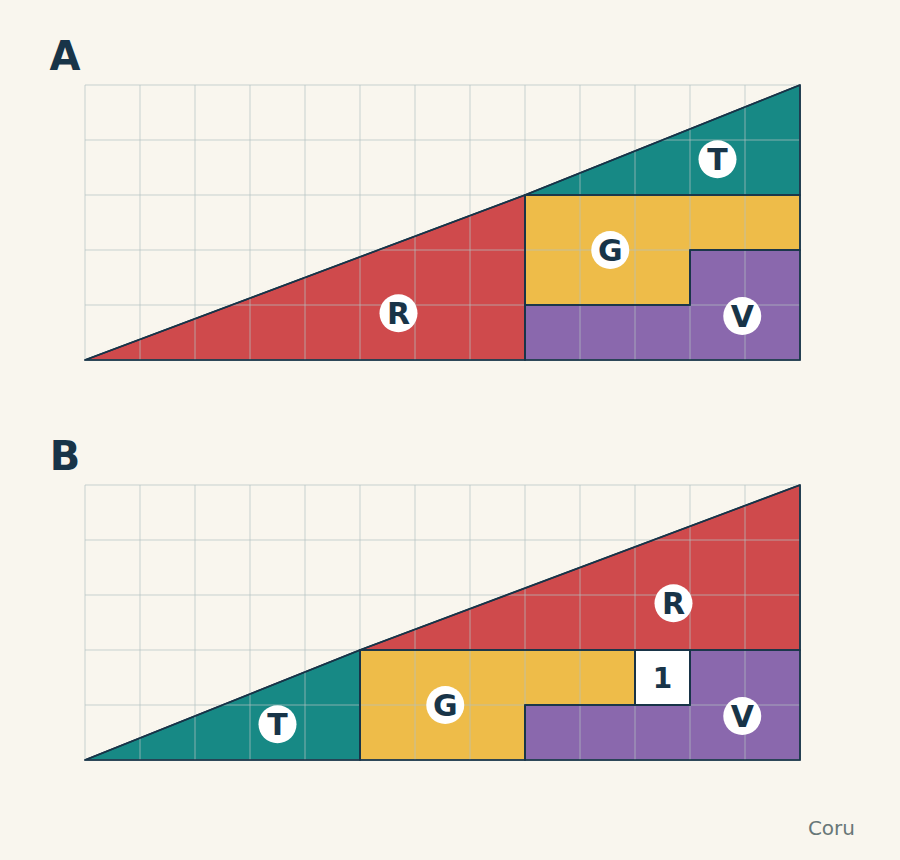
Four pieces make shape A. Move the same pieces into shape B and a square hole appears. Nothing was cut away. Before looking for a missing piece, ask what else might have changed.
Same pieces. One empty square.
The two arrangements below use exactly the same four pieces. R and T are triangles; G and V are stepped shapes. The letters let you follow each piece without relying on its colour. Each grid cell is one square unit.
A has no gap. B has a one-cell hole. Both reach 13 units across and 5 units high. Look at the long sloping edge before scrolling to the explanation.
Make a prediction
Choose a possible explanation, or continue to the full answer below. The answer list also remains available without JavaScript.
Answers and explanations
- One piece has become smaller: The vertices and dimensions of every piece stay the same. Try following the letter on each piece between A and B.
- The outer boundary encloses more area: Yes. The long sloping edge changes slightly, so B encloses more area.
- The same triangle can have two different areas: A fixed triangle has one area. Check the assumption that either large outline is a triangle.
The reveal: the long edge is bent
Neither large outline is a triangle. Each has four sides: the apparent long diagonal is actually two segments with slightly different slopes. In A the join bends inward; in B it bends outward. The change is small enough to hide in a thick pencil line.
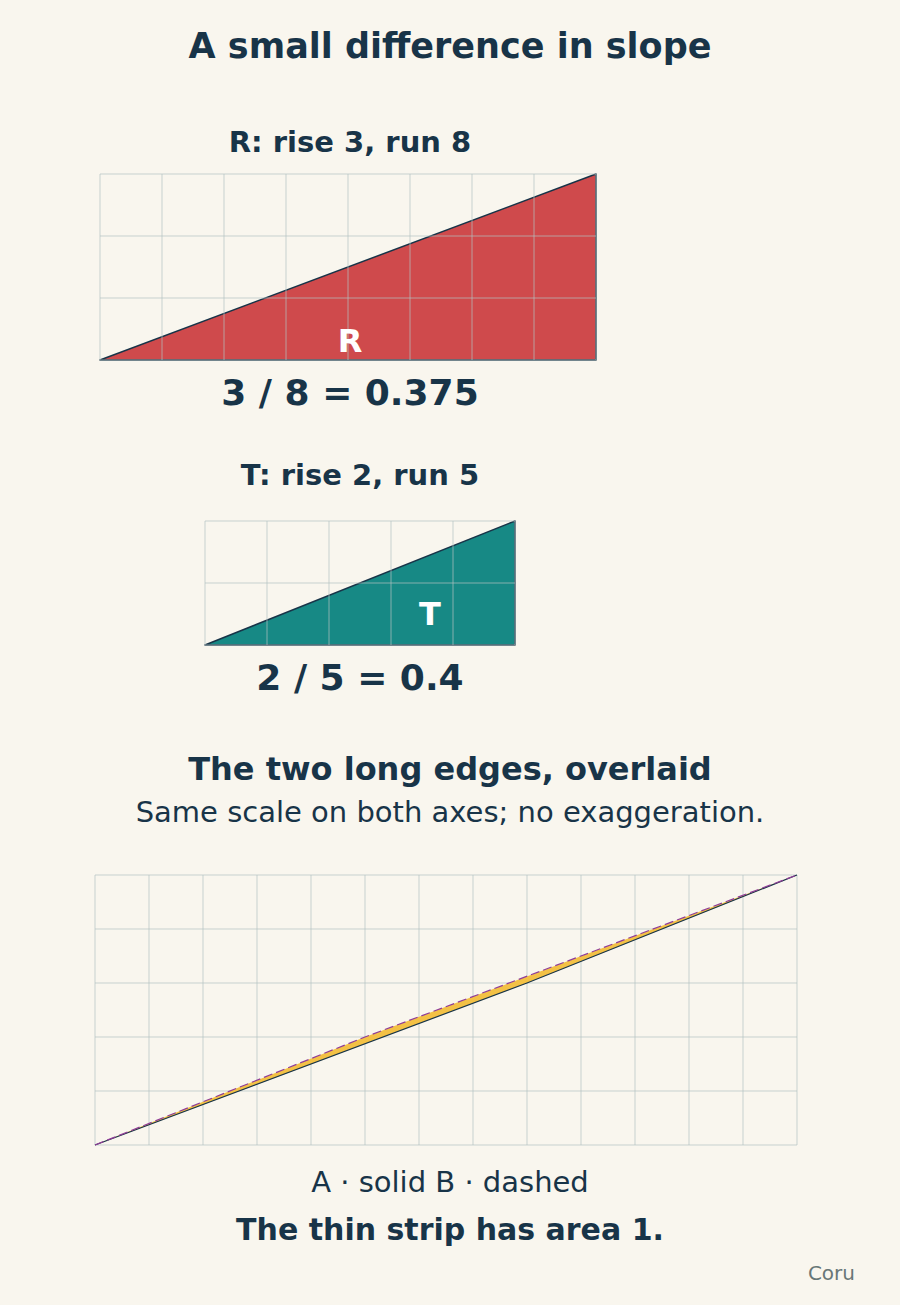
The red triangle R rises 3 units over a run of 8: its slope is 3/8 = 0.375. The teal triangle T rises 2 over 5: its slope is 2/5 = 0.4. For their sloping sides to form one straight line, those slopes would have to match. They do not.
The area was hiding along the edge
The pieces occupy 12 + 5 + 8 + 7 = 32 square units in either arrangement. Shape A encloses 32. Shape B encloses 33, of which 32 are filled by the pieces and 1 is the hole.
Overlay just the two outer boundaries, keeping the bottom edge and right-hand edge aligned. The thin strip between their sloping edges has area exactly 1. That is the extra space enclosed by B. It equals the hole’s area; no piece has lost material.
A genuine right triangle with base 13 and height 5 would have area 13 × 5 ÷ 2 = 32.5. That value belongs to the straight reference triangle, not to either bent outline. A is half a square unit smaller than that triangle; B is half a square unit larger.
Try it with paper and a ruler
Print the cut-out kit below. Cut out only R, T, G and V along the outer boundaries; the grid lines are guides, not cuts. Keep all four pieces at the same scale. Use the two target outlines to build A and B, without bending or overlapping pieces.
Lay a ruler between the left tip and the top-right corner of each assembled shape. Look at where R meets T. Do not press the pieces into a straight edge: that would change the arrangement you are testing.
Paper thickness, wide printed lines and small cutting errors can hide the bend. If the physical result is ambiguous, compare the labelled dimensions: 3/8 and 2/5 are different regardless of how convincing the drawing looks.
Print the missing square cut-out kit
Two A4 pages: four separate pieces, then two assembly guides. Print both pages at the same scale. At 100%, a grid unit is 10 mm; check the 50 mm calibration line.
For a precise check
Take the bottom-left tip as (0,0). The right-hand edge runs from (13,0) to (13,5). In A, the sloping edge passes through (8,3); in B, it passes through (5,2). The straight line joining (0,0) to (13,5) would pass through (8,40/13) and (5,25/13). Each join differs vertically from that line by 1/13 of a grid unit, on opposite sides.
These small offsets explain why the illusion survives a quick glance. The useful habit is to check the property a picture appears to promise. “Looks like a triangle” was the hidden assumption; “has a straight sloping edge” is the test.
A puzzle to pass on
This is the classic missing square puzzle, not a new Coru invention. The diagrams, cut-out sheet and explanation here were made for this article. HBCSE/TIFR also presents the puzzle as a way to compare the slopes.
If you try it with someone, ask for their explanation before showing the ruler test. Which changed their mind: the unequal slopes, the paper model, or the area calculation? You can tell us using the feedback form below.