The coin is rigged in your favour. Try not to go broke.
You have $25 and 30 flips. Let us see what is left.
Your game
The buttons or the ← → keys; digits 1–5 change the stake.
Heads comes up 60% of the time, tails 40%. Toy money.
The game on paper, with a die
Start with $25. Roll an ordinary die: 1, 2 or 3 is heads, 4 or 5 is tails, 6 means roll again. That makes heads exactly 60%.
Before each roll, write down your stake and your side. Add what you win, take off what you lose. Play 30 rolls.
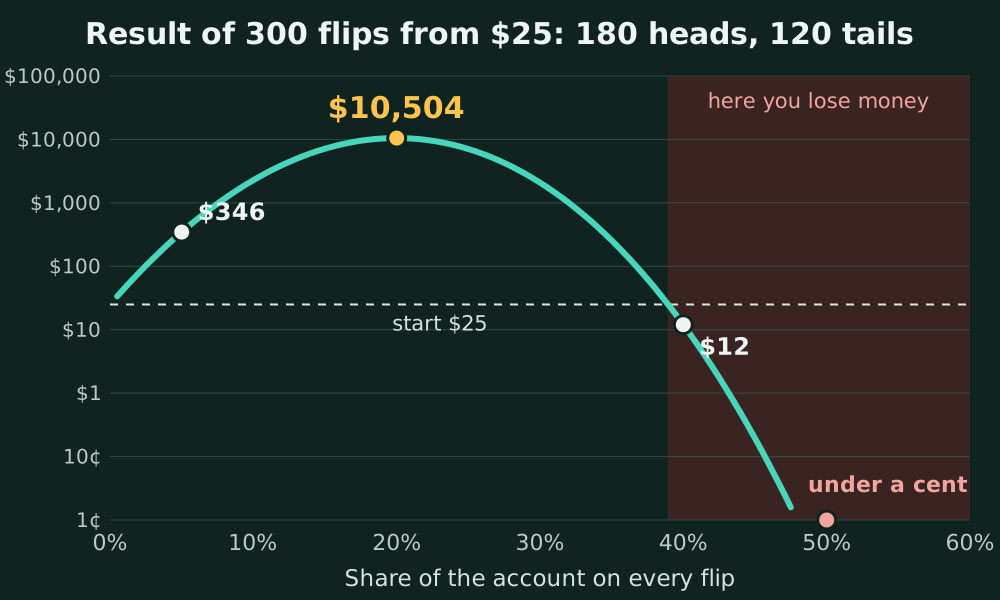
The table gives the result of 300 flips with every bet on heads, a constant share of the balance, and exactly 180 heads and 120 tails.
| Stake on every flip | Result from $25 |
|---|---|
| 1% | $44.88 |
| 5% | $346 |
| 10% | $2,279 |
| 15% | $7,142 |
| 20% | $10,504 |
| 25% | $7,065 |
| 30% | $2,087 |
| 40% | $12.00 |
| 50% | under a cent |
Spoilers from here
Everything below explains how to play this game. Play at least once first: it takes a couple of minutes.
Who was handed this coin
In a study written up in 2016, Victor Haghani and Richard Dewey sat 61 people down at their laptops: students of economics and finance and young professionals at finance firms, including 14 analysts and associates from two leading asset managers. Each got a real $25 and 30 minutes. A statement in bold said the simulated coin came up heads 60% of the time. They could bet any amount on either side. At the end each received a check for their balance, up to $250. Nobody heard about that cap until a bet could break through it.
The authors assumed these people should have been well prepared for a simple game with a positive expected value.
What they did
28% went bust and got nothing. A third ended with less than they started with. Only 21% reached the cap. By the authors' simulations, a constant bet of anywhere from 10% to 20% of the account should have got 95% of them there.
18 people bet everything on a single flip at least once. 41 bet on tails at some point, and 29 did so more than five times. The 13 who backed tails on more than a quarter of their flips were more likely to do it right after a string of heads, although the coin remembers nothing. And of those who answered the question, 75% believed the coin really was biased.
The strangest number is the average bet: only 15% of the account. On average they were careful. What sank them was the spread: too small, then too big, with quite a few raising the stake after a loss to win it back.
Who was testing them
The authors' paper opens with an invitation to a talk by a hedge fund manager, a partner at a fund "that famously flopped about twenty years ago". Victor Haghani was one of the founding partners of Long-Term Capital Management. At the end of 1997 that fund held about $30 of debt for every $1 of capital. In September 1998 a group of 14 banks and brokerage firms, brought together by the Federal Reserve, put in $3.6 billion to prevent its imminent collapse.
So "how much?" is not a textbook exercise for him. His lectures still make the point that in finance you have to decide how much to invest, not just what to invest in.
Why not bet it all
Every bet on heads is a good bet, and the bigger it is, the more you win on average. So why not bet everything? John Kelly of Bell Labs took that temptation apart in 1956. It would indeed maximise your average result, he wrote, but that "would be little comfort": over many bets you would probably be broke, and if you kept going, certainly.
The trap is that a win and a loss do not cancel out. Bet 20%: a win multiplies your account by 1.2, a loss by 0.8, and together they make 0.96. Bet 50%: 1.5 and 0.5, together 0.75. The bigger the share, the more each such pair eats.
Here is what that does to a perfectly average game: 300 flips, 180 heads, 120 tails, every bet on heads. Same coin, same flips. At 20%, $25 becomes $10,504. At 40% it becomes $12: you lost money on a coin rigged in your favour. At 50% you are left with less than a cent.
The average player is rich, the typical player is broke
Even at 20%, the average result across all possible games would be $3,220,637, and the typical one just that same $10,504. At 50% the gap turns absurd: an average of about $65 trillion, while the typical player is left with less than a cent. A handful of impossibly lucky runs make up the average, and about 87% of games end below the starting $25. You only get to play one game, and nobody pays you the average of all of them.
Kelly's rule is simple: bet a constant share of 2p − 1, where p is your chance of winning. Here that is 2 × 0.6 − 1 = 20%. The stake shrinks by itself after losses, which keeps the risk of ruin close to zero.
Of the 61 players, five had heard of Kelly, and it did not help two of them: one barely doubled his money, the other only broke even after about 100 flips. The authors could not find it in the finance syllabi of five leading American business schools.
This is not investment advice
The formula works here because you were told the exact odds. The authors say so themselves: in the market nobody can tell you the distribution, and extreme events happen far more often than in coin flips. Kelly also assumes a higher tolerance for risk than most people have, so the full share is not required: in this game, betting 10% or 15% gave the same 95% chance of reaching the cap. At 5% or 40% it fell to about 70%.
If the edge is not on your side, the same formula gives zero or less, which means do not bet at all. Nobody is likely to offer you a coin rigged in your favour in real life. This page is about how a bet works, not about where to put your money.
Play again, but boringly
Try it: 20% on heads, 30 times in a row, whatever comes up. Notice how much you want to do something else. The authors suspect that is the whole problem: a sound but boring strategy may be easy to stick to for 30 minutes and impossible for 30 weeks, months or years.
How our game differs
The real game had about 300 flips in half an hour, real money and a $250 cap. Ours has 30 flips by hand, toy money and no cap, because the lines would hit it and you could not see where they lead. After that the page plays on: your habit is your own bets, each a share of the account and a side, in random order. All 300 flips are fixed by a random number before your first bet, so the game cannot adapt to you. We ran the generator for a million flips and heads came up 60.0% of the time.
In the count over 1,000 games we use the authors' definition of bust: under $2 at the end. The table, the figure, the $65 trillion and the 87% are our own arithmetic from the paper's formulas; the $10,504 matches the authors' result.
Sources & further reading
- Victor Haghani, Richard Dewey. Rational Decision-Making Under Uncertainty: Observed Betting Patterns on a Biased Coin, working draft, 19 October 2016
- J. L. Kelly, Jr. A New Interpretation of Information Rate. Bell System Technical Journal, July 1956
- Federal Reserve History: Near Failure of Long-Term Capital Management
- Chat With Traders, episode 129: Victor Haghani
- Wikipedia: The Missing Billionaires
- Elm Wealth: Victor Visits Columbia Business School